Loading...
Please wait while we load the content...

Loading...
Please wait while we load the content...
Stay informed about our latest publications, calls for proposals, author news, events, and special announcements.
Join our community of scholars, librarians, authors, and readers and receive the latest updates from Vernon Press directly in your inbox.
Availability
Pre-order
ISBN
9798261600862
Edition
1
Publication Date
September 1, 2026
Physical Size
236mm x 160mm
Currency
Quantity
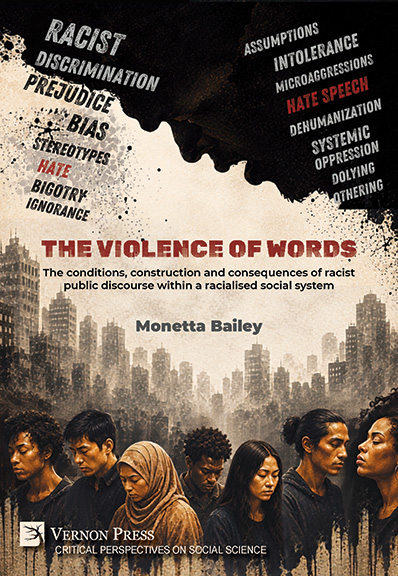
Monetta Bailey’s “The violence of words: The conditions, construction and consequences of racist public discourse within a racialized social system” is a timely and theoretically sophisticated intervention into one of the most pressing issues confronting contemporary pluralist societies: the relationship between discourse, power, and harm. Drawing on the complementary insights of Critical Race Theory and the sociology of knowledge, Bailey offers a compelling account of how racist public discourse is not merely expressive but constitutive—shaping identities, structuring social relations, and reproducing racialized hierarchies within what she convincingly conceptualizes as a “racialized social system.”
What distinguishes this work is its ability to bridge the often-separated domains of theory and lived experience. Through a careful integration of discourse analysis and empirical data—including focus groups and counter-narratives—Bailey demonstrates that the harms of racist speech extend beyond the material into the psychological, social, and existential realms. Her analysis of “new racism,” characterized by coded and ostensibly race-neutral language, is particularly incisive, revealing how contemporary public discourse sustains historical inequities under the guise of liberal neutrality.
Importantly, Bailey does not stop at diagnosis. She advances a bold normative argument for rethinking how harm is defined in relation to public discourse, challenging entrenched liberal assumptions about the primacy of unfettered freedom of expression. In doing so, she contributes meaningfully to ongoing debates in Canada and beyond about the limits of speech, the responsibilities of the state, and the conditions necessary for genuine equality and human dignity.
This is an important and courageous book. It will be of significant interest to scholars of sociology, critical race studies, political theory, and communication, as well as to policymakers grappling with the regulation of harmful speech in democratic societies. Bailey’s work is a valuable addition to the growing body of scholarship that insists we take seriously the power of words—not only to reflect the world, but to shape it.
Dr. W. Andy Knight
Distinguished University Professor
Provost Fellow, Black Excellence and Leadership
University of Alberta
Dr. Bailey used her book to highlight the racist discourse that impacts our communities and society in Canada. This book is timely and needed in higher education to discuss that words matter. In 10 chapters, it highlighted the impact of words through the stories of participants who shared their lived experiences. I cannot imagine how challenging yet beneficial it was for participants to share their realities. I have no doubt that this book will be read widely, contested, yet tell the truth about the violence of words and the trauma that individuals endure. So many lessons to take from the pages that are academically and socially powerful.
Prof. Dr. Marva J. Ferguson
Department of Child Studies and Social Work
Mount Royal University
This timely and thought-provoking book challenges dominant narratives about race and multiculturalism in Canada, compelling readers to examine how language both reflects and reproduces racial inequality. It reminds us that language is never neutral and invites us to rethink how we speak about race. An important contribution to conversations about racism, discourse and social justice, Bailey invites critical reflection on the power of words in shaping a more equitable society.
Prof. Dr. Monica Pauls
Chair, Department of Child Studies and Social Work
Mount Royal University
“…in Canada, the refusal to have open discussions of race intensifies the harm individuals experience.” This, to me, is the crux of, and the value of this book. Dr. Bailey makes a masterful job of discussing a touchy subject with academic clarity which is also accessible to the curious reader in everyday life. Given the times we live in where the internet “democratizes speech,” this book is topical, timely, and bold, giving us something new to chew on and act on as we encounter the public discourses on race and race-adjacent topics.
Prof. Dr. Rita Yembilah
Senior Researcher, Canadian Poverty Institute
Ambrose University
Discover books that expand on the themes explored in this work—titles that engage with similar questions, intersecting disciplines, and complementary perspectives to deepen understanding and broaden the conversation.
Browse all titles
Beverley A. Searle (Ed.)
View more
Luiz Valério P. Trindade
View more